
Treasures New and Old
Treasures New and OldGenesis: Chapter Eleven: Language
This month and next month we will dive into Chapter 11 of Genesis and take a deep dive into the languages issue that was sparked by man’s desire to be like God and reach to the Heavens to make a name for himself – Babel and the results.
Outline:
- One language in the world (vs. 1-4)
- The confusion of tongues/languages (vs. 5-9)
- The generations from Seth to Abraham (vs. 10-32)
One People-One Language: Genesis 11:1-4:
And the whole earth was of one language, and of one speech. And it came to pass, as they journeyed from the east, that they found a plain in the land of Shinar; and they dwelt there. And they said one to another, Go to, let us make brick, and burn them thoroughly. And they had brick for stone, and slime had they for mortar. And they said, Go to, let us build us a city and tower, whose top may reach unto heaven; and let us make us a name, let we be scattered abroad upon the face of the whole earth.
Observations:
One language: (Strong’s H8193): saphah sepheth: “( . . . in dual and plural) . . . the lip (as a natural boundary); by implication language; by analogy a margin (of a vessel, water, cloth, etc.):- band, bank, binding, border, brim, brink, edge, language, lip, prating, ([sea-]) shore, side, speech, talk, [vain] words.”
One speech: (Strong’s H1697): dabar: . . . a word; by implication a matter (as spoke of) of thing; adverbial a cause: – act, advice, affair, answer . . . decree . . . judgement.”
- Who migrated “from the east” to the plain of Shinar?
- Where was east of Shinar? (see map)
- Who built Babel? Where is Babel? Is it the city of Babylon? Shinar would be “land of two rivers,” a name closely related in meaning to the Greek “Mesopotamia.” We would look for Shinar somewhere in a territory that includes two rivers and east of the mountains of Ararat.
Confusion of Tongues: Genesis 11:5-9:
And the LORD came down to see the city and the tower, which the children of men built. And the LORD said, Behold, the people is one, and they have all one language; and this they begin to do: and now nothing will be restrained from them, which they have imagined to do. Go to, let us go down, and there confound their language, that they may not understand one another’s speech. So the LORD scattered them abroad from thence upon the face of all the earth: and they left off to build the city. Therefore is the name of it called Babel; because the LORD did there confound the language of all the earth: and from thence did the LORD scatter them abroad upon the face of all the earth.
- Babel: (Strong’s H894): confusion, base of the word Babylon, Babylonian, etc.
- Genesis 11:8 (bold added): “So the LORD scattered them abroad from thence upon the face of all the earth: and they left off to build the city.”
- Lord in Genesis 11:5-9 is YAWH (Jehovah)
- Verse 7: “let us go down . . .” a single Hebrew word (yarad) implied plural (Qal Cohortative-Jussive): Qal: verb, active voice, intention and/or desire for an action. Cohortative: ” . . . let me go over.” (Deuteronomy 3:25). Jussive: ” . . . that thou mayest have strength when thou goest . . .” (1 Samuel 28:22) (Baker).
Some Observations
- The Khabur triangle is located in northeast Syria. The upper Khabur RIver and its tributaries make up this triangle. Some think the three cities in Nimrod’s kingdom: Erech, Akkad, and Calneh, are actually Tell Aqab (relatively near Amudah), Tell Birak, and Tell Fakhariya (relatively near As Safih). So, Nimrod’s tower of Babel is probably somewhere near these cities.
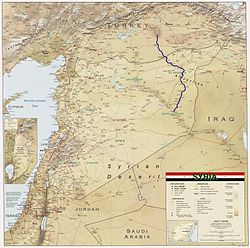
F.1 Khabur River Region
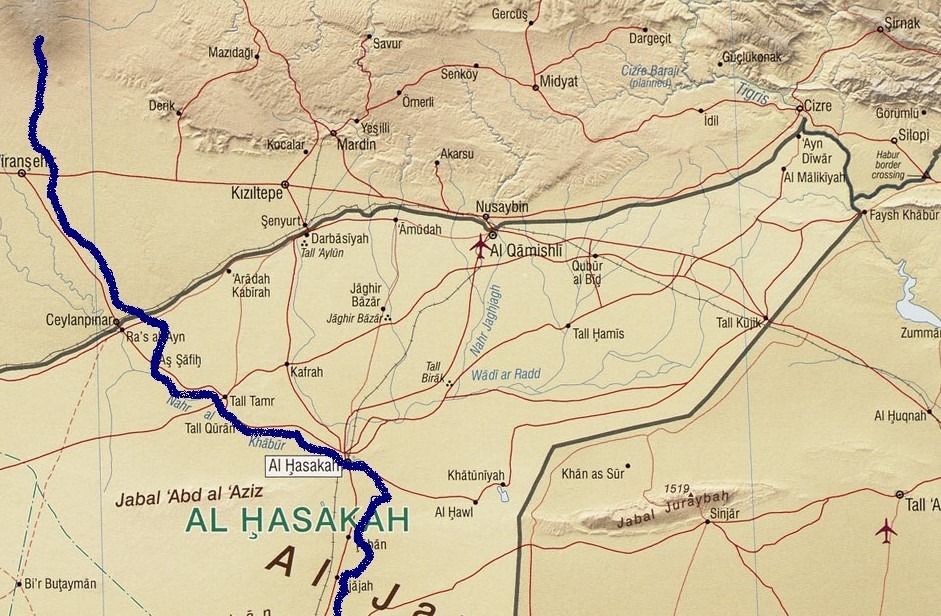
F.2 Khabur River Region cropped
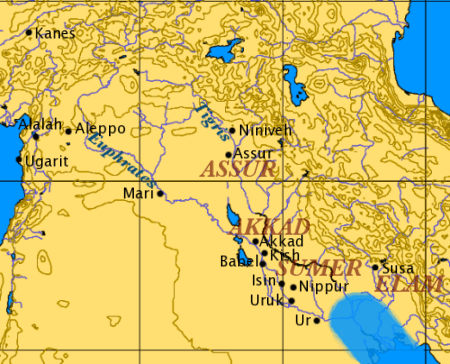
F.3 Mesopotamia
- A tell (also spelled tel, til, or tal) is not a natural hill. These are locations of ancient cities that for a myriad of reasons were destroyed or partly destroyed over and over again and then rebuilt. After hundreds of years or longer in this cycle a “hill” formed as the city rose on the rubble below. Eventually, these cities were abandoned and time and wind erased any outward urban markers.
Shem to Abraham: Genesis 11:10-26:
And Shem lived after he begot Arphaxad five hundred years, and begot sons and daughters. And Arphaxad lived five and thirty years, and begot Salah: And Arphaxad lived after he begot Salah four hundred and three years, and begot sons and daughters. And Salah lived thirty years, and begot Eber: And Salah lived after he begot Eber four hundred and three years, and begot sons and daughters. And Eber lived four and thirty years, and begot Peleg: And Eber lived after he begot Peleg four hundred and thirty years, and begot sons and daughters. And Peleg lived thirty years, and begot Reu: And Peleg lived after he begot Reu two hundred and nine years, and begot sons and daughters. And Reu lived two and thirty years, and begot Serug: And Reu lived after he begot Serug two hundred and seven years, and begot sons and daughters. And Serug lived thirty years, and begot Nahor: And Serug lived after be begot Nahor two hundred years, and begot sons and daughters. And Nahor lived nine and twenty hears, and begot Terah: And Nahor lived after be begot Terah a hundred and nineteen years, and begot sons and daughters. And Terah lived seventy years, and begot Abram, Nahor, and Haran.
- “Begat sons and daughters” – this genealogy is to show direct descendants, but God wanted us to know lots of others were also born to these people.
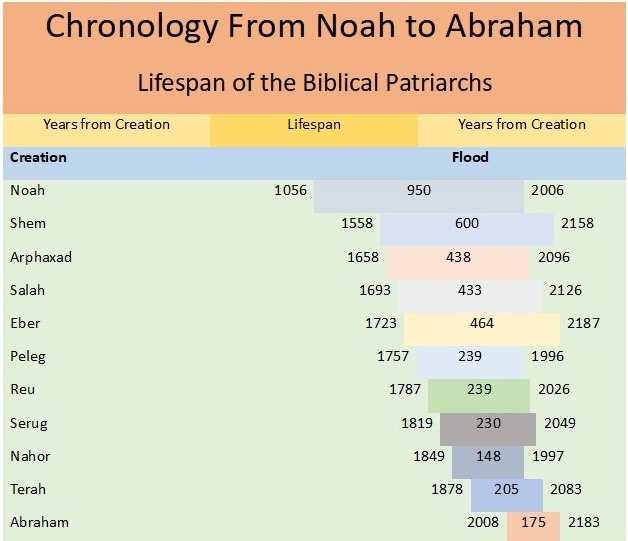
Notice the significant drop in age over these ten generations. The first ten generations (Adam to Noah) had some variety but generally maintained long (nine hundred plus years) life spans. Some say that is due to the special environment found on the earth before the flood. But the harsher conditions after the flood, our DNA mutations and corruption, and many diseases contributed to shorter lifespans.
Maranatha!
Bro. Joe
Baker, W. AMG’s Complete Word Study Bible. AMG International. (2008). Wordsearch Bible. [computer software]. Nashville, TN: LifeWay Christian Resources. (Original work published 1994)
CIA. (2004). Kahbur River in Syria 2004 CIA map. [map] Wikimedia Commons. Retrieved from: https://commons.wikimedia.org/wiki/File:Khabur_River_in_Syria_2004_CIA_map.jpg

Dbachmann. Mesopotamia. [map] Wikimedia Commons. Retrieved from: https://commons.wikimedia.org/wiki/File:Mesopotamia.PNG

Strong, J. Strong's Hebrew and Greek Dictionaries. Meyers, R. (2005). e-Sword. [computer software] . Franklin, TN: Equipping Ministries Foundation. (Original work published 1890)