
Treasures New and Old
Treasures New and OldGenesis: Chapters Seven & Eight: Evidences for the Flood
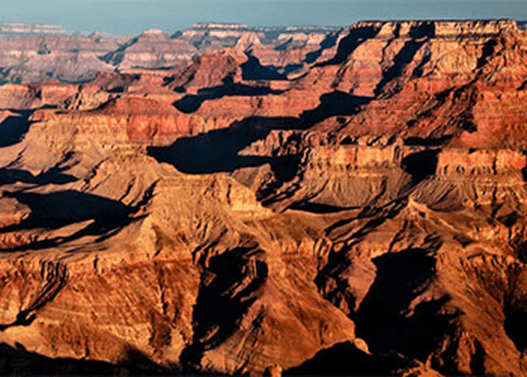
The evidence for Noah’s flood is literally all around the globe in a variety of geological formations and materials. Secular science looks at the very same formations and materials as do creation scientists, but see a very different world. Until Mount St. Helens erupted in 1980 through 1982, scientists were inclined to see all of the levels of lines and canyons, like the Grand Canyon, as representing river sediment laid down over millions of years. By the way, I note that there aren’t millions of layers. There do appear to be thousands but not millions.
However, that sediment evidence can also be interpreted as the many sediment layers caused by water movement from a flood that has been receding over time. One would assume waves washing back and forth dropping different levels of sediment, then settling for a while, and then something else causes the waves to move again, stir up the sediment, and, behold, another layer has been set down.
The various evidences that Dr. Steve Austin, Ph. D; Andrew A. Snelling, B.Sc.(Hons), Ph.D; and Dr. Harold Coffin, Ph.D have gleaned from studying the Mount St. Helens eruption, as well as other areas like the Grand Canyon, the Petrified Forest, and similar sites around the world, represent small cataclysmic events that can easily be expanded to explain the vast cataclysmic event of Noah’s flood.
It would be important to note that neither secular scientists nor creation scientists living today or even several hundred years ago were at Noah’s flood. Therefore, neither group can say as an eyewitness this is how it happened. But God was an eyewitness, and He has written down, through Moses in the Book of Genesis, how it happened. Man looks at the evidence left behind through the view of his worldview filter. Creationists use God-lens for their filter, whereas secular humanists, who refuse to accept God or that a creator was indeed involved, choose to use the evolution model to try to explain what is otherwise unexplainable.
I list in this article, a companion to last month’s and next month’s articles, additional proofs provided by creation scientists that Noah’s flood really happened the way God said it did in the Book of Genesis. So, let’s dig in:
Key Scientific Findings about the Eruption of Mount St. Helens (Steve Austin Ph.D (see also the Austin photographs at the end of this article)).
Here are six key findings
1. Ash Cloud and Rapid Cooling – Mount St. Helens blasted enough ash into the atmosphere to blanket multiple states and cool the earth a fraction of a degree. The earth’s rock layers show abundant evidence of a huge number of massive volcanic eruptions throughout the closing stage of the flood and the years immediately following the flood. These eruptions dwarfed Mount St. Helens. (An eruption at Yellowstone was one thousand times as big!) So, if the comparatively small Mount St. Helens eruption could cool the earth, it is easy to see how multiple volcanic eruptions contributed to the rapid onset of the Ice Age.
2. New Lava Rock with Old Radiometric Dates – Post-eruption rock studies revealed the fallibility of scientific radiometric dating methods. A ten-year-old rock sample from Mount St. Helens’ last lava flow was dated at 350,000 years old using the potassium-argon method. Minerals inside were dated up to 2.4 million years old. These reports are consistent with many reports about faulty radiometric dating samples around the world. Radiometric dating methods have been unquestioned by an unknowing public but are fraught with problems due to faulty assumptions.
3. Rapid Coal and Petrified Forests – The eruption destroyed the surrounding forests and produced a mat of logs floating on nearby Spirit Lake. Douglas firs, as tall as two hundred feet, were instantly stripped of their branches and snapped like toothpicks. The logs jostled together lost their bark, producing a pile of peat (like peat in coal). Many logs floated vertically and then sank in layers (like a petrified forest). Geologists have typically assumed that upright buried logs represent multiple forests that grew at different periods over many thousand or even millions of years (it’s how scientists interpret this at Specimen Ridge in Yellowstone National Park). Similarly, secular scientists believe that coal beds form very slowly, accumulating organic material in swamp lands where plants grew in place (one thousand years to form one inch of coal). Spirit Lake at Mount St. Helens shows that coal beds can and do form rapidly due to catastrophic destruction of forests, not slow plant growth in swamps. The flood would have destroyed the earth’s forests in a matter of weeks, and the floating logs would produce bark that then sank to form most of the earth’s coal layers.
4. Rapid Sedimentary Layers – The eruptions at Mount St. Helens triggered several different earth-shaping forces. The original blast was followed by landslides, steam water mudflows, and falling ash. Even the water in nearby Spirit Lake was temporarily pushed out of its basin and came crashing back into place. These catastrophes produced complex sediment layers up to six hundred feet thick. Several slurries of volcanic ash produced many different fine layers in just minutes. Mount St. Helens teaches us that sedentary layering does form very rapidly by catastrophic flow processes, such as those which occurred during the Genesis Flood.
5. Hard Rock Layers within One Year – The six-hundred-foot canyon of sedimentary layers created by the mud flows and ash quickly solidified into rock within one year, making the newly formed canyon looking very aged.
6. Tree Drop out at Spirit Lake – Massive tree mats float on Spirit Lake as a result of the scouring of the mountain sides by the volcanic gases. As they get waterlogged, they drop to the bottom, usually trunk end first (widest part of the tree), thus, giving the illusion of a tree planted in the mud at the bottom of the lake.
The following pictures are from Geologist Andrew A. Snelling, B.Sc. (Hons), Ph.D. (Geology), taken from several of his articles published on the Answers in Genesis website.
1) Evidence for the flood of Noah:
Rapid movement of plates created mountain tops

2) Evidence for the flood of Noah:
Rapidly buried plants and animals

3) Evidence for the flood of Noah:
Rapidly deposited sediment layers across the continents
4) Evidence for the flood of Noah:
Long transport distance of sediments

5) Evidence for the flood of Noah:
Rapid or no erosion between sediment layers

6) Evidence for the flood of Noah:
Whole rock layer sequences deposited rapidly in quick succession

Following photos by Harold Coffin, Ph.D Geology, paleobotany from various published articles such as “The Yellowstone Petrified ‘Forests'”
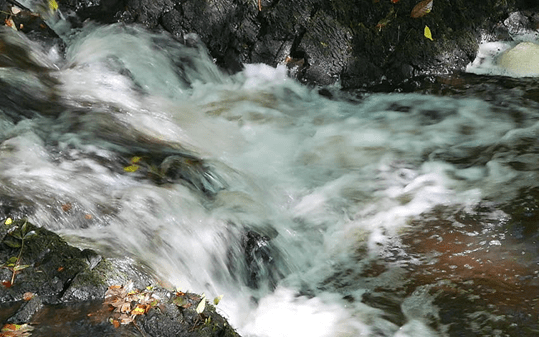
1) Fast moving water
2) Conglomerate

3) Redwall and other beds

4) Decay rate of fish fossils
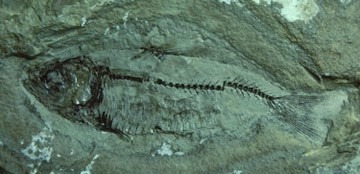
5) Massive plant and animal graveyards

6) Widely diverse fossil mixtures

The following pictures taken from Dr. Steve Austin Ph.D Geology; “The Yellowstone ‘Petrified Forest’ – Evidence for Rapid Burial”.
#1 Large log mats in Spirit Lake after Mount St. Helens eruption
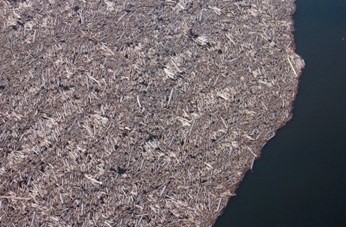
#2 Logs naturally begin to get waterlogged in their base and then “stand up” in the water before dropping to the lake bottom.

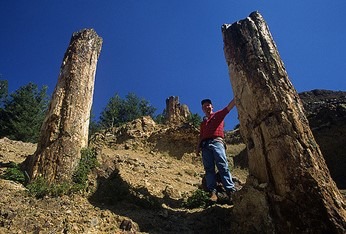
#3 Petrified tree standing up at Specimen Ridge, Yellowstone, look a lot like those logs that fell out in Spirit Lake, standing upright then rapidly buried so that they can be petrified.
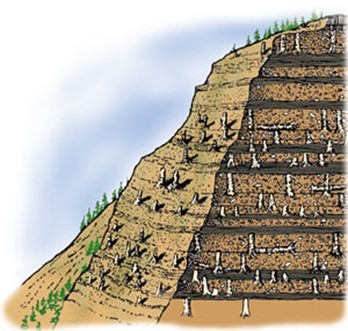
#4 A depiction if a “polystrate tree” within sedimentary layers, showing upright fossilized trees extending through multiple layers of rock. This is a classic illustration from Dr. Steve Austin’s work on the Yellowstone Petrified Forests. It shows numerous “layers” of log drop outs that were rapidly buried while sediment continued to flow into the area.
This concludes this month’s article on proofs regarding Noah’s Ark. Next month we will wrap up the last portion of Chapter 8 in Genesis where God makes a covenant with Noah that is actually a covenant with all mankind. A promise never to destroy the earth again with a flood and a promise that includes regular seasons, plantings and harvest, day and night, and hot and cold seasons.
Maranatha!
Bro. Joe
(If you desire to more specifics what scholars believe/conjecture/have studied about the flood, find creationist material from places like Answers in Genesis, Institute for Creation Research, Dr. Morris, and there are many more.)
Austin, S. (April 1, 2015). “Lasting Lessons from Mount St. Helens”. Answers in Genesis. (2025). Retrieved from: https://answersingenesis.org/geology/mount-st-helens/lasting-lessons-mount-st-helens/?srsltid=AfmBOorWClOkntXVYqpZzu3U-qNCDQF3QCrr1a-1YzBdH-Nrxpz4nRJJ
Austin, S. (1994). The Yellowstone ‘Petrfied Forests’ – Evidence for Rapid Burial. Proceedings of the Third International Conference on Creationism. Pittsburgh, PA: Creation Science Fellowship.
Coffin, H. (1997). The Yellowstone Petrified ‘Forest‘. Origin. 24.1 PDF. (Geoscience Rewarch Institute)
Snelling, A. Answers in Genesis. (2025). Retrieved from: https://answersingenesis.org/bios/andrew-snelling/articles/